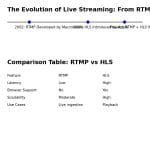
RTMP = speed. HLS = compatibility. Many servers now use both.
Main brand: RTMP-Server.com (RTMP hosting with Wowza backbone).
Internal: hosting-marketers.net (TV mode automation).
External: Wowza Docs.
Choosing the right protocol for a live event is a balancing act between speed and compatibility, an equation best solved today not by picking one protocol, but by using both RTMP and HLS in tandem. The old standard, RTMP (Real-Time Messaging Protocol), is the uncontested winner for pure speed and low-latency contribution. It’s built on the Transmission Control Protocol (TCP), which maintains a persistent stateful connection, making it highly effective for quickly transporting the raw encoded video stream from the broadcaster’s encoder (like OBS Studio) to the streaming server. This makes RTMP the ideal protocol for the first mile of delivery, ensuring minimal delay in the ingest phase. However, RTMP has been largely phased out for viewer-facing distribution due to its legacy reliance on Flash technology and poor native support on modern web browsers and mobile operating systems. Conversely, HLS (HTTP Live Streaming), originally developed by Apple, is the champion of compatibility and reach. HLS works over standard HTTP/HTTPS, utilizing the same network infrastructure as basic web pages, which allows it to pass through firewalls easily and scale efficiently using standard Content Delivery Networks (CDNs).
The primary trade-off between the two protocols defines their roles in the modern streaming pipeline. RTMP’s inherent design delivers a consistently low latency, typically in the range of 1 to 5 seconds, making it excellent for applications where real-time interaction or minimal delay is critical, such as live auctions, gaming streams, or on-stage confidence monitors. However, HLS, by design, breaks the video stream into small, consecutive segments (typically 2 to 10 seconds long) and delivers them via a manifest file. This segmentation is fundamental to its robustness, as it enables automatic Adaptive Bitrate (ABR) streaming—allowing the player to seamlessly switch between different quality streams based on the viewer’s network conditions—thereby preventing buffering and ensuring a reliable stream. The trade-off for this massive reliability and wide-device reach is higher latency, typically in the 10 to 30-second range, though innovations like Low-Latency HLS (LL-HLS) are striving to reduce this to under 2 seconds. Therefore, for most major live events, the strategic choice is not RTMP or HLS, but how best to combine them: RTMP for low-latency ingest to the server, and HLS for wide-reaching, reliable distribution to the final audience.
Modern streaming servers have evolved to be dual-protocol experts, using a powerful media server backbone—often a managed service running software like Wowza Streaming Engine—to automatically manage the necessary transcoding and re-packaging process. Services from a specialized provider, such as those that offer RTMP hosting with a Wowza backbone, are essential for event streamers. The server receives the RTMP stream, and without stopping, automatically transcodes or re-packages the stream into the HLS segments required for distribution. This means the content creator only needs to manage a single, fast RTMP stream from their encoder. The server handles the complexity of creating the multiple ABR HLS renditions, securing the stream, and delivering the manifest to global viewers with a single, reliable URL. This architecture effectively harnesses the best of both worlds: the speed of RTMP for the contribution link and the universal compatibility and reliability of HLS for the final delivery. This integrated approach not only maximizes viewer satisfaction by delivering a high-quality stream to every device but also provides the necessary platform for advanced features, such as 24/7 TV mode automation for continuous channel programming.
You can learn more about how different protocols work by watching this Video Streaming Protocols Explained: RTSP, RTMP, HLS, & DASH for Beginners.